

Healthcare SEO Company: Content Clusters and Topic Authority
Aug 25, 2026


Healthcare consumers increasingly use search engines to find doctors, clinics, hospitals, treatments, specialists, and answers to health-related questions. If your healthcare website does not appear prominently for relevant searches, you may miss valuable opportunities to connect with patients and build trust.
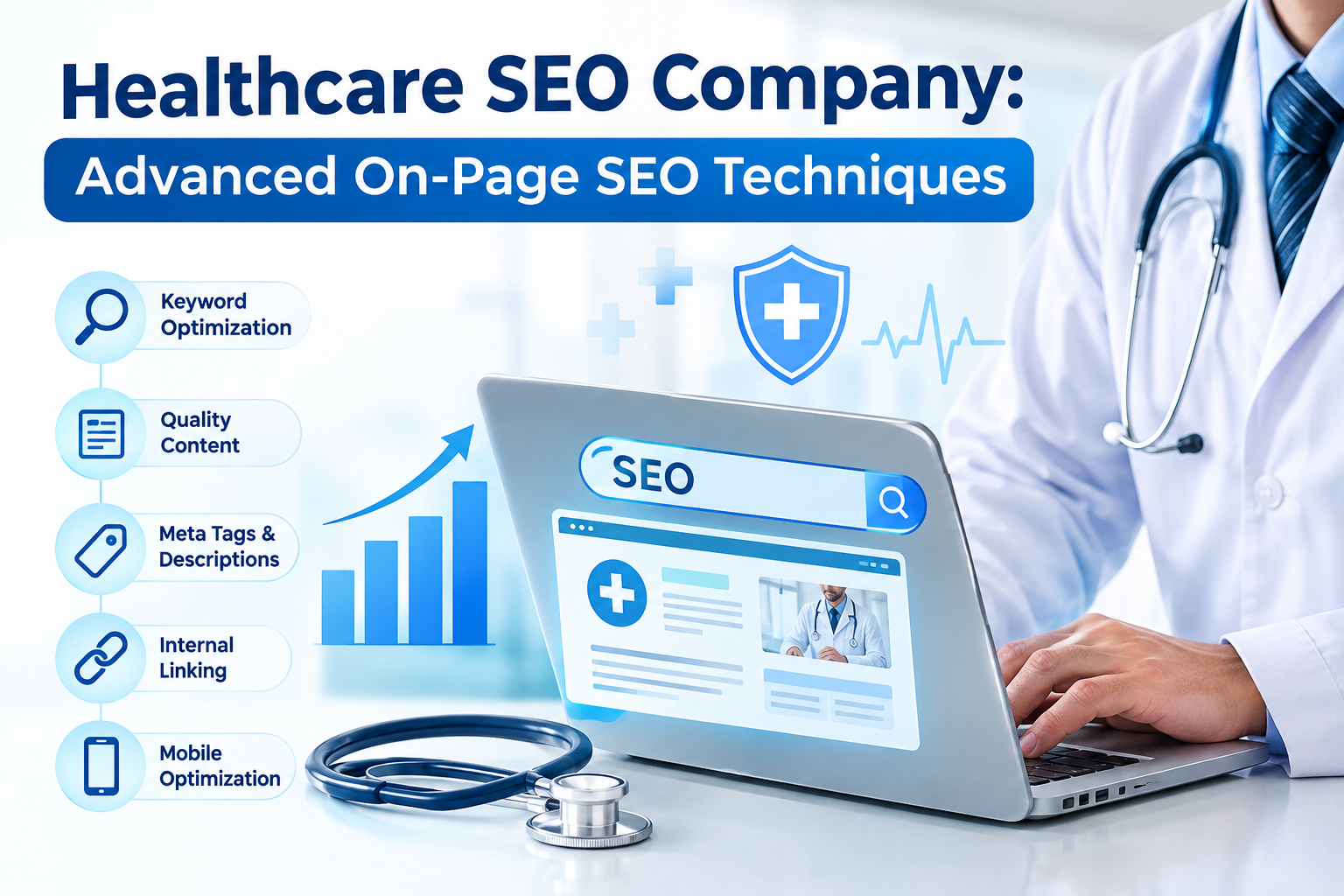
Advanced on-page SEO helps you improve how search engines understand your website while making your content more useful to visitors. Instead of focusing only on keyword placement, you need to consider search intent, content depth, page structure, internal links, local relevance, entities, user experience, and trust signals.
Working with an experienced Healthcare SEO Company can help you develop a consistent strategy across service pages, educational content, provider profiles, and location pages. You can also apply many of these techniques internally to strengthen your website’s organic visibility.
Before optimizing any page, identify what your audience wants to find.
Healthcare searches generally fall into several categories. Informational searches seek answers, commercial searches compare services or providers, navigational searches look for a specific organization, and local searches focus on nearby healthcare options.
For example:
Your content should directly address the purpose behind the search. If users want to understand a treatment, explain the treatment clearly. If they are searching for a local provider, provide relevant location and service information.
Matching intent prevents your pages from becoming generic keyword-focused content and gives visitors a more useful experience.
Your title tag should tell users and search engines exactly what your page covers.
Include the primary topic naturally and add a location when local visibility is important. Avoid repetitive titles across multiple pages.
For example:
Poor:
Healthcare Services | Healthcare Treatment | Healthcare Provider
Better:
Comprehensive Family Medicine Services in Austin
The second title identifies the service and location without unnecessary repetition.
Create unique titles for your main service pages, condition pages, provider profiles, blog posts, and location pages. Make each title accurately reflect the content users will find after clicking.
A logical heading structure makes healthcare content easier to navigate and understand.
Use one clear H1 for the primary subject, followed by relevant H2 and H3 headings.
For example:
H1: Personalized Diabetes Treatment in Chicago
H2: What Does Diabetes Treatment Include?
H2: Who May Benefit From Diabetes Care?
H2: What to Expect During an Appointment
H2: Our Approach to Patient Care
H2: Frequently Asked Questions
This structure helps visitors find information quickly. It also provides search engines with additional context about the relationships between different sections of your content.
Keyword stuffing can make healthcare content difficult to read and may reduce its usefulness. Instead, build topical depth around the main subject.
Suppose you are creating a page about cardiovascular care. Naturally relevant subjects could include:
You do not need to repeat the exact target keyword in every paragraph. Use related terminology naturally and answer the questions your audience is likely to ask.
This creates more comprehensive content while maintaining a natural second-person reading experience.
Healthcare content requires a high level of trust because readers may use information to make important decisions. Your website should demonstrate experience, expertise, authoritativeness, and trustworthiness.
You can strengthen these signals by providing:
Make sure every credential, qualification, claim, and medical statement is accurate and verifiable.
When appropriate, display who created or reviewed the content. This gives visitors greater confidence in the information and helps establish your website as a credible resource.
Search engines increasingly understand websites through entities and relationships rather than isolated keywords.
For healthcare websites, important entities can include medical professionals, healthcare organizations, specialties, conditions, treatments, locations, and services.
For example, a page about cardiology could naturally discuss cardiovascular health, cardiologists, heart disease, diagnostic services, preventive care, and related treatments.
The goal is not to insert as many related terms as possible. Instead, clearly explain how relevant concepts connect to the main topic.
Consistent provider information, organization details, service descriptions, location information, and appropriate structured data can further help search engines understand your healthcare business.
Internal linking is an essential part of advanced on-page SEO.
Instead of using generic anchor text such as “click here,” use short, descriptive phrases that explain what the linked page contains.
For example:
Place links naturally within relevant sentences. Avoid adding multiple links to the same destination unnecessarily.
A strong internal linking structure can help visitors move from informational articles to relevant services. It can also help search engines discover important pages and understand your site’s topical relationships.
Topic clusters can strengthen your website’s overall topical coverage.
Start with a broad pillar page, such as:
Then create supporting content around related subjects, including:
Link these pages strategically so users can move between related resources.
This approach gives your website a clear content structure and allows you to cover important questions at different stages of the search journey.
If you serve patients in specific cities or regions, local SEO should be part of your on-page strategy.
Create useful location-specific pages for important service areas. Include the location naturally in relevant titles, headings, content, and metadata.
For example:
is more meaningful than repeatedly using phrases such as “Denver pediatric care” throughout the page.
Each location page should offer unique value. Include relevant services, provider information, appointment details, areas served, and other useful local information.
Avoid creating dozens of nearly identical pages that only replace one city name with another. Thin location pages can provide little value to users.
Also maintain consistent business information across your website and other important local listings.
Your meta description should encourage qualified users to visit your page.
A strong description explains what the page offers and why the information may be useful.
For example:
Discover personalized cardiology services, treatment options, and patient-focused care from experienced specialists in Denver.
Keep descriptions natural and relevant. Do not turn them into lists of keywords.
Although your meta description is not a substitute for high-quality content, a clear description can help users understand your result before they visit the page.
Images can improve understanding, especially when you explain complex medical subjects.
Healthcare websites commonly use:
Optimize these assets by compressing large files, selecting appropriate dimensions, and using descriptive file names.
Add meaningful alt text where appropriate. Describe what the image actually shows rather than filling the alt attribute with keywords.
Image optimization can support accessibility, usability, page speed, and image-search visibility.
Even excellent content can underperform when a page is slow, unstable, or difficult to use.
Review your website’s loading performance and mobile experience regularly. Pay attention to factors such as:
Keep important content accessible without excessive scrolling, pop-ups, or complicated navigation.
A healthcare visitor should be able to quickly find services, provider information, appointment details, phone numbers, and answers to common questions.
Structured data can help search engines interpret important information about your website and organization.
Depending on your content, potentially relevant schema types may include Organization, LocalBusiness, MedicalOrganization, Physician, Article, BreadcrumbList, and other applicable types.
Only implement structured data that accurately represents information available on the page. Incorrect or misleading markup can create problems rather than improving visibility.
Keep your structured data updated whenever important business or content information changes.
AI-powered search systems increasingly provide direct answers to user questions. Your content should therefore be organized so important information is easy to identify and understand.
Use question-based headings where appropriate and provide concise answers before expanding with supporting details.
For example:
Healthcare SEO is the process of optimizing a healthcare website to improve its visibility for relevant searches while making its content easier for users and search engines to understand.
You can then explain the topic in greater depth.
This format supports Answer Engine Optimization because important answers are clearly presented. It can also make your content more useful for voice search and conversational queries.
Healthcare information should not remain unchanged indefinitely. Treatments, guidelines, terminology, services, provider details, and organizational information can change.
Review important pages periodically. Check for:
When you update substantial content, ensure the changes genuinely improve accuracy and usefulness rather than simply changing the publication date.
People increasingly search using complete questions rather than short keywords.
Instead of optimizing only for:
“cardiologist Chicago”
consider the questions your audience may ask:
Answer these questions naturally throughout your content.
This conversational approach supports AEO, voice search, and AI-driven search experiences while making your pages more helpful to real users.
After providing useful information, give visitors a clear next step.
Your CTA should match the user’s stage in the journey. An informational article might encourage readers to explore a related service, while a service page can encourage appointment inquiries or consultations.
Avoid aggressive CTAs that interrupt the educational value of healthcare content.
A simple option is:
If you need a strategic approach to healthcare search optimization, you can Contact our SEO team to discuss your website, goals, target audience, and search visibility opportunities.
SEO should be treated as an ongoing process.
Monitor organic traffic, rankings, impressions, click-through rates, conversions, engagement, indexed pages, and landing-page performance. Use these insights to identify pages that need improvement.
If an important page receives impressions but few clicks, review its title and meta description. If it ranks but does not generate conversions, evaluate its content, intent alignment, trust signals, and CTA.
Regular testing helps you make decisions based on actual performance rather than assumptions.
Advanced on-page SEO involves optimizing healthcare content, headings, metadata, internal links, entities, structured data, user experience, local relevance, and search intent to improve visibility and usefulness.
E-E-A-T helps demonstrate that your healthcare content is reliable and produced with appropriate expertise. Accurate credentials, trustworthy sources, transparent information, and qualified reviews can strengthen visitor confidence.
Internal links connect related healthcare pages, help users discover useful information, and give search engines additional context about your website’s content structure and important topics.
Create genuinely useful location-specific pages, use consistent business information, optimize relevant service content, strengthen local signals, and provide clear information about the areas and services you serve.
Use clear question-based headings, concise answers, comprehensive topical coverage, trustworthy information, structured content, and strong entity relationships. These practices make healthcare information easier for AI-powered search systems to interpret.