

Healthcare SEO Company: Keyword Research for Medical Websites
Aug 18, 2026


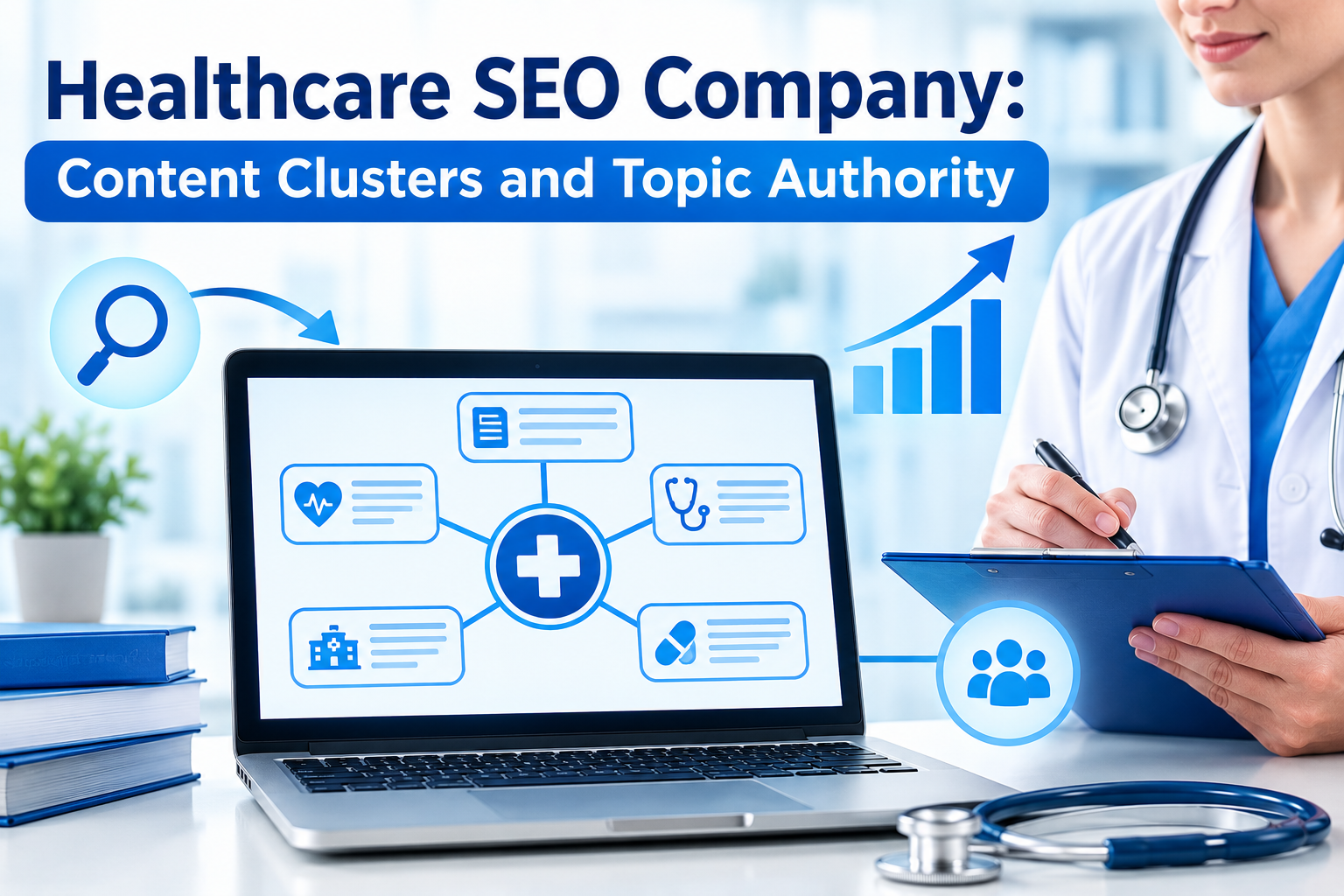
When patients search for healthcare information, they often ask several related questions before deciding what to do next. They may search for symptoms, treatment options, providers, costs, locations, risks, and recovery guidance. If your healthcare website only targets individual keywords with disconnected blog posts, you may struggle to demonstrate depth and relevance.
A stronger approach is to build content clusters and topic authority around the healthcare subjects your audience cares about most.
With a well-planned content cluster strategy, you create one comprehensive pillar page supported by several closely related articles. You then connect these pages through relevant internal links. This structure helps users find useful information while making it easier for search engines and AI-powered search systems to understand your expertise.
If you work with a Healthcare SEO Company, you can use content clusters to organize your website around services, conditions, treatments, locations, and patient questions rather than isolated keywords.
A content cluster is a group of related pages built around one broad healthcare topic.
The structure usually includes:
For example, suppose your healthcare website focuses on anxiety treatment. Your pillar page could explain anxiety treatment in detail. Supporting pages might cover symptoms, therapy options, when to seek help, treatment approaches, frequently asked questions, and local treatment services.
Instead of competing with your own pages, each article serves a specific purpose.
Topic authority means demonstrating broad and meaningful knowledge about a subject rather than publishing a few pages that target high-volume keywords.
This is particularly important for healthcare websites because users need accurate, trustworthy information before making decisions.
A strong topic authority strategy helps you:
You should not create content simply to increase the number of URLs on your website. Every page should have a clear purpose and provide information that genuinely helps your audience.
Before creating a content cluster, choose a core subject that aligns with your services and audience.
Your core topic could be:
Start by identifying the topics that are commercially and informationally important to your organization.
For example, a dental practice could develop a cluster around dental implants. A dermatology practice could focus on acne treatment. A mental health provider could build a cluster around anxiety therapy.
The subject should be broad enough to support multiple useful subtopics but specific enough to maintain topical relevance.
Once you select a core topic, research the questions your audience asks.
Do not focus exclusively on traditional keyword volume. Look for different types of search intent.
You can categorize queries into:
These searches typically seek education.
Examples include:
Users are comparing possible solutions.
Examples include:
Users want healthcare services in a particular area.
Examples include:
These users are closer to taking action.
Examples include:
Mapping these intents helps you create content that supports users throughout their decision-making journey.
Your pillar page should provide a comprehensive overview of the primary topic.
However, comprehensive does not mean unnecessarily long. Focus on usefulness, organization, and clarity.
A strong healthcare pillar page can include:
You can then link to more detailed cluster pages whenever readers need additional information.
Your pillar page should function as the central resource that connects the entire topic.
After creating the pillar page, identify narrower subjects that deserve their own pages.
For example, a healthcare treatment cluster might contain pages covering:
Each article should answer a distinct question rather than repeating the same information.
This approach allows you to cover a topic deeply while maintaining a useful page structure.
Internal linking is one of the most important components of a content cluster.
Instead of adding links randomly, connect pages according to their relationships.
For example, your pillar page might link to five detailed cluster articles. Those articles can link back to the pillar page and, where relevant, connect to other supporting pages.
Use descriptive anchor text that tells readers what they will find after clicking.
Instead of generic phrases such as “click here,” use descriptive anchor text such as:
For your website’s commercial page, use the descriptive anchor text “Healthcare SEO Company” where it naturally fits. This gives both users and search engines clearer context about the destination.
For conversion-focused navigation, use “Contact Us” or a more descriptive variation such as “Contact our healthcare SEO team.”
Because the URLs were not included in your prompt, add your approved destination URLs to these anchor texts before publishing.
A large content cluster can create problems if multiple pages target the same intent.
For example, creating five articles that all target variations of “anxiety treatment” may cause your pages to compete against each other.
Before publishing a new article, ask:
If two pages serve nearly identical purposes, consider combining them rather than creating unnecessary competition.
Search behavior is changing as users increasingly interact with AI-powered search systems and conversational tools.
Your content should therefore be easy for both humans and machines to understand.
Use:
For AEO, answer important questions directly before expanding with supporting detail.
For example, if the question is “What is a content cluster?” begin with a concise definition and then explain how the strategy applies to healthcare websites.
This structure makes information easier to extract and understand in answer-based search experiences.
Healthcare content requires a strong emphasis on trust.
Your content strategy should support Experience, Expertise, Authoritativeness, and Trustworthiness (E-E-A-T).
Where appropriate, demonstrate expertise through:
Avoid making exaggerated promises. Healthcare users need factual information they can understand and evaluate.
Your SEO strategy should support credibility rather than simply pursuing rankings.
If you serve patients in specific locations, integrate local search intent into your content strategy.
You can create useful location-focused pages around services and areas you genuinely serve.
For example, you might develop pages for:
However, avoid creating dozens of nearly identical city pages simply by replacing the location name. Each local page should contain genuinely useful information about the service, provider, location, patient needs, and available options.
Keep your business information consistent across your website and relevant local listings.
Publishing content is only the beginning.
Track performance at both the individual-page and cluster levels.
Monitor:
You may discover that one cluster page attracts significant traffic while another receives little visibility. Use those insights to improve your content strategy.
Update outdated information, strengthen weak sections, improve internal links, and combine overlapping pages when necessary.
Topic authority does not come from publishing a large number of articles in a short period.
It develops through consistent, organized, useful coverage.
Start with your most important healthcare services and patient questions. Build one strong pillar page, create relevant supporting content, connect the pages with logical internal links, and continually improve the cluster based on performance and user needs.
You can then expand into related topics without losing focus.
A Healthcare SEO Company can help you identify content gaps, organize keyword groups, develop topic clusters, improve internal linking, and align your content strategy with healthcare search behavior.
Your ultimate goal should not be to create content for search engines alone. You should create resources that help people understand their options and take appropriate next steps.
Before publishing each page, ask yourself:
When you consistently answer these questions, your content becomes more useful, structured, and trustworthy.
A healthcare content cluster is a group of interconnected pages focused on one healthcare topic. A comprehensive pillar page provides the main overview, while supporting pages answer narrower questions and address related search intents.
Content clusters help you organize related information, strengthen internal linking, cover multiple search intents, and demonstrate comprehensive knowledge about important healthcare topics.
There is no fixed number. Start with the questions and subtopics that genuinely matter to your audience. A cluster may contain several supporting pages or expand significantly as your topic coverage grows.
Yes. You can incorporate location-specific services and patient questions into relevant clusters. Each local page should provide unique, useful information rather than simply repeating the same content for different locations.
Review important healthcare content regularly and whenever information, services, guidelines, or business details change. Prioritize pages that receive significant traffic or influence patient decisions.
A structured content cluster strategy gives your healthcare website a clearer path to topical relevance, stronger internal linking, and better user navigation. By combining pillar pages, supporting content, local SEO, AEO-friendly formatting, trustworthy information, and continuous optimization, you can build a website that serves both users and modern search systems.
If you need help developing a healthcare content strategy, use the descriptive anchor text “Healthcare SEO Company” to link to your relevant service page. When you are ready to discuss your goals, add “Contact Us” as the descriptive CTA anchor text pointing to your approved contact page.
Build a connected content ecosystem that answers patient questions, supports local visibility, and establishes meaningful topic authority. Review your existing content, identify gaps, create focused clusters, and connect every page with a clear purpose.