

Healthcare SEO Company: Internal Linking for Healthcare Websites
Sep 5, 2026


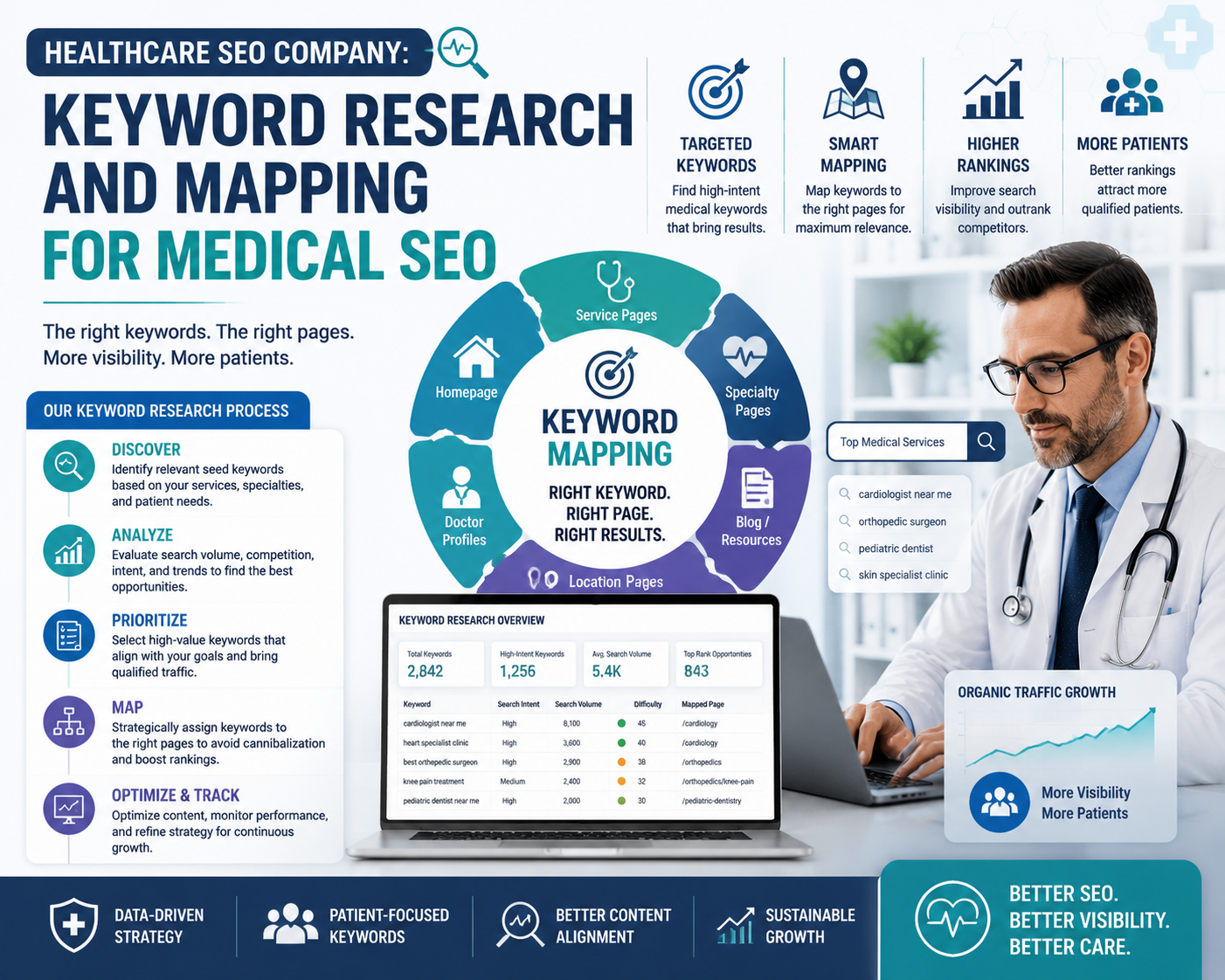
Finding the right patients online starts with the right keywords. Whether you manage a private practice, specialty clinic, dental office, hospital, or telehealth service, your website needs a strategic keyword plan that matches how patients search for healthcare services. Without proper keyword research and mapping, even a well-designed medical website may struggle to attract qualified traffic.
Working with a Healthcare SEO Company helps you identify high-value search terms, organize them across your website, and create content that satisfies both search engines and patients. An effective keyword strategy improves rankings, enhances user experience, and supports long-term organic growth while following healthcare SEO best practices.
This guide explains how keyword research and keyword mapping strengthen your medical SEO strategy and help you reach more local patients.
Healthcare searches are highly specific. Patients search using symptoms, treatments, conditions, specialists, insurance questions, and local locations. If your website does not target these search terms, potential patients may never discover your services.
Professional keyword research helps you:
Instead of guessing which keywords to use, you make informed decisions based on real search behaviour.
Keyword mapping is the process of assigning specific keywords to individual pages on your medical website.
Rather than targeting the same keyword across multiple pages, every page focuses on a unique search intent. This prevents keyword cannibalisation while helping search engines understand your website structure.
For example:
A professional Healthcare SEO Company creates a complete keyword map that supports every stage of the patient journey.
Successful medical SEO focuses on search intent rather than keyword volume alone.
Healthcare searches generally fall into four categories:
Patients want information before seeking treatment.
Examples include:
These searches work well for educational blog articles.
Patients already know the healthcare provider.
Examples include:
These searches strengthen your brand visibility.
Patients compare providers before making a decision.
Examples include:
Optimised service pages perform well for these searches.
Patients are ready to book an appointment.
Examples include:
These keywords should appear on appointment and service pages.
Effective keyword research combines multiple keyword types.
These represent your core services.
Examples include:
These keywords usually appear on primary service pages.
Supporting keywords provide additional relevance.
Examples include:
These naturally strengthen topical authority.
Long-tail keywords often convert better because they match specific patient needs.
Examples include:
Long-tail searches often have lower competition and higher conversion potential.
Local SEO remains essential for healthcare providers.
Examples include:
Location-based keywords help patients find nearby healthcare services.
Every page should serve one primary purpose.
A typical medical website may include:
Target your primary healthcare service while introducing your practice and expertise.
Create dedicated pages for every treatment you provide.
Examples include:
Each page targets unique service-related keywords.
If you serve multiple cities, create unique location pages instead of duplicating content.
Each page should include:
This improves GEO and Local SEO performance.
Educational content expands your keyword coverage.
Topics may include:
Blogs answer patient questions while supporting your service pages through internal linking.
Modern search extends beyond traditional rankings.
Patients now receive answers through AI-powered search engines, voice assistants, and generative search experiences.
Keyword mapping helps your website perform well by:
AI-powered search rewards websites that provide complete, trustworthy, and well-organised information.
Healthcare belongs to Google’s Your Money or Your Life (YMYL) category, making trust extremely important.
Keyword research should support E-E-A-T principles:
Share real patient care insights and practical healthcare knowledge.
Highlight qualified medical professionals and specialised services.
Publish comprehensive content covering healthcare topics in depth.
Keep medical information accurate, updated, and transparent.
When keyword mapping supports these principles, your website becomes more credible for both users and search engines.
Many healthcare websites reduce their SEO potential by making avoidable mistakes.
Common issues include:
A structured keyword strategy eliminates these problems.
Internal links help both patients and search engines navigate your website.
For example, your blog about diabetes management can link to your endocrinology service page.
A treatment page can link to:
Use descriptive anchor text naturally throughout your content.
Suggested internal anchor texts include:
Natural internal linking distributes authority across your website while improving the user experience.
Keyword research is an ongoing process.
Monitor metrics including:
Review your keyword map regularly and update content as patient search behaviour changes.
Healthcare search continues to evolve with artificial intelligence, voice search, personalised recommendations, and location-based results.
Your keyword strategy should adapt by:
A future-focused keyword strategy ensures your medical website remains competitive as search technology advances.
Successful medical SEO begins with strategic keyword research and careful keyword mapping. Every page on your website should answer a specific patient need while supporting your overall SEO goals.
A trusted Healthcare SEO Company helps you discover valuable search opportunities, organise your website effectively, improve local visibility, and create patient-focused content that aligns with AI search, AEO, GEO, and Google’s E-E-A-T guidelines.
If you’re ready to improve your medical website’s visibility, attract qualified patients, and build sustainable organic growth, Contact Us to discuss a customised healthcare SEO strategy tailored to your practice.
Keyword research helps you understand what patients search for, allowing you to create relevant content that improves rankings, attracts qualified visitors, and increases appointment opportunities.
Keyword mapping assigns specific keywords to individual website pages, preventing keyword overlap while improving search visibility and user experience.
Local SEO targets location-based searches, helping nearby patients find your healthcare services through local search results and map listings.
Review keyword research every three to six months or whenever services, patient demand, or search trends change significantly.
Yes. AI-optimised, AEO-focused content answers patient questions clearly, improves visibility in AI-powered search results, and strengthens overall organic performance.
Get Your Free SEO Consultation